
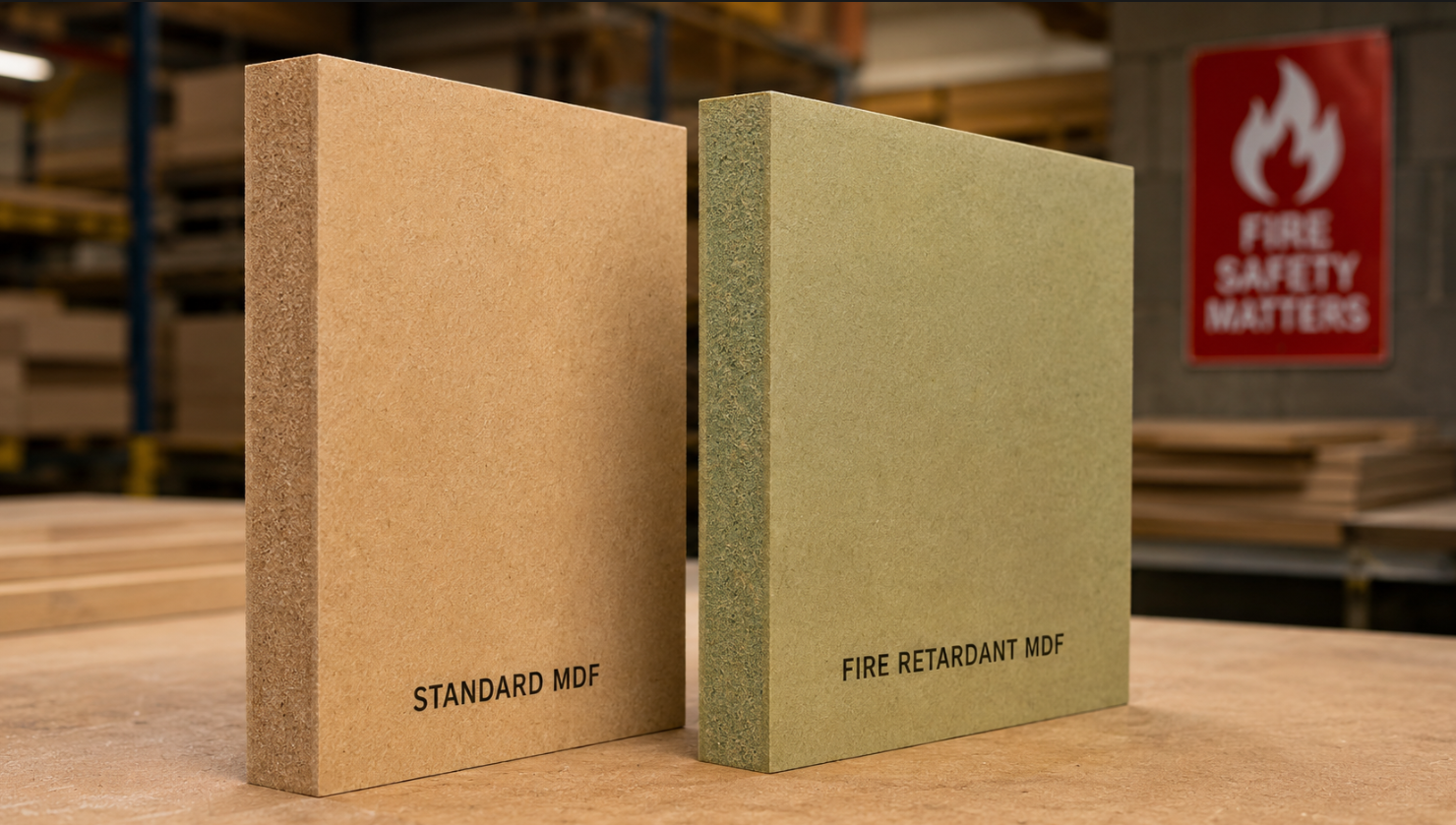
Fire Retardant MDF vs Standard MDF: What’s the Difference?
Fire Retardant MDF vs Standard MDF: What’s the Difference?
MDF is one of the most versatile sheet materials used across construction, joinery, shopfitting, exhibitions, film and television, theatre scenery and commercial interiors. However, not every MDF board offers the same performance.
For projects where fire performance is an important consideration, fire retardant MDF (FR MDF) may be specified instead of standard MDF.
Although the two products can look relatively similar, there are significant differences in their intended applications and fire performance.
Understanding these differences can help contractors, designers, set builders, shopfitters and specifiers choose the appropriate material for their project.
What Is Standard MDF?
Medium Density Fibreboard, usually known simply as MDF, is an engineered wood-based panel manufactured from wood fibres combined with resin and compressed under heat and pressure.
The manufacturing process creates a smooth, consistent board without the knots and grain variations associated with natural timber.
This makes MDF particularly useful where a smooth surface, accurate machining or high-quality painted finish is required.
Standard MDF is widely used for applications including:
- Furniture manufacture
- Cabinetry
- Shelving
- Interior joinery
- Wall panelling
- Display units
- Exhibition construction
- Theatre scenery
- Film and television sets
- Shopfitting
- Decorative interior features
One of MDF’s biggest advantages is its consistency.
Because the material has a relatively uniform structure throughout the board, it can be cut, routed, drilled and machined into complex shapes.
It also provides an excellent surface for painting and other decorative finishes.
However, standard MDF is not manufactured specifically to provide enhanced reaction-to-fire performance.
Where a project requires a particular fire classification, a suitable fire retardant board may therefore be required.
What Is Fire Retardant MDF?
Fire retardant MDF, often abbreviated to FR MDF, is an MDF panel designed to provide improved reaction-to-fire performance compared with standard MDF.
Depending on the specific product, thickness, installation and certification, fire retardant MDF can achieve defined classifications when tested to recognised standards.
FR MDF is therefore commonly considered for projects where building specifications, venue requirements or project-specific fire-performance requirements call for a board with documented fire characteristics.
Typical applications can include:
- Commercial interiors
- Public buildings
- Schools and educational buildings
- Hotels
- Restaurants
- Retail environments
- Exhibition stands
- Theatre scenery
- Television studios
- Film sets
- Museums and galleries
- Office fit-outs
- Display systems
Creffields supplies specialist fire retardant MDF and other fire retardant sheet materials for a wide variety of commercial and creative applications.
Fire Retardant MDF vs Standard MDF
The fundamental difference is their intended fire performance.
Standard MDF is designed primarily as a versatile interior sheet material.
Fire retardant MDF combines many of the useful characteristics associated with MDF with enhanced reaction-to-fire performance.
| Characteristic | Standard MDF | Fire Retardant MDF |
|---|---|---|
| Smooth surface | Excellent | Excellent |
| Machinability | Excellent | Excellent |
| Suitable for painting | Yes | Yes |
| Interior joinery | Yes | Yes |
| Enhanced reaction-to-fire performance | No specific FR classification as standard | Yes, according to the specific certified product |
| Commercial interiors | Commonly used | Often specified where enhanced fire performance is required |
| Film/TV scenery | Commonly used | Useful where specified fire performance is required |
| Exhibition construction | Commonly used | Frequently considered where venue/project requirements demand FR materials |
| Theatre scenery | Commonly used | Often considered where fire performance is important |
| Certification | Product dependent | Fire classification documentation should be checked |
The correct board should always be selected according to the requirements of the individual project.
Is Fire Retardant MDF Fireproof?
No.
The terms fire retardant, fire resistant and fireproof are sometimes used interchangeably in everyday conversation, but they do not necessarily mean the same thing.
Calling a wood-based panel “fireproof” can be misleading.
Fire retardant MDF is designed to provide an improved reaction to fire compared with conventional MDF, but this does not mean that the material cannot burn under any circumstances.
Its performance is assessed under controlled testing procedures and expressed using recognised classifications.
For this reason, the tested classification and supporting documentation are much more useful than simply describing a product as “fireproof MDF”.
Understanding Euroclass Fire Classification
For construction products in the UK and Europe, reaction-to-fire performance may be classified according to EN 13501-1.
The Euroclass system includes classifications ranging from:
A1 → A2 → B → C → D → E → F
with additional classifications relating to smoke production and flaming droplets or particles where applicable.
Rather than assuming that all products described as “fire retardant MDF” perform identically, buyers and specifiers should check the classification of the particular product being considered.
Factors including board type, thickness, mounting and installation conditions can affect the scope of a classification.
Creffields provides access to technical information and relevant product documentation to help customers select suitable materials.
Why Use Fire Retardant MDF?
There are several reasons why FR MDF may be selected.
Improved Fire Performance
The most obvious advantage is enhanced reaction-to-fire performance compared with standard MDF.
This can make FR MDF appropriate where a particular fire classification forms part of the project’s specification.
Excellent Machining Properties
FR MDF retains many of the characteristics that make MDF attractive to manufacturers and fabricators.
Depending on the particular product, it can be:
- Cut
- Drilled
- Routed
- Profiled
- Machined
- Painted
- Decorated
This makes it particularly useful for projects involving detailed or bespoke components.
Smooth Surface
MDF provides a smooth and consistent surface that can be ideal for painted finishes.
This is particularly valuable in:
shopfitting, exhibitions, television sets, film scenery and theatre production, where the finished appearance is extremely important.
Consistent Board Structure
Unlike natural timber, MDF does not contain conventional knots or grain patterns.
Its consistent structure allows designers and fabricators to create repeatable components and detailed profiles.
Fire Retardant MDF for Film and Television Sets
Film and television production has long been an important market for specialist sheet materials.
Sets frequently require materials that can be:
- Quickly fabricated
- Accurately machined
- Painted
- Sculpted or routed
- Used to create convincing architectural features
- Installed within demanding production environments
MDF is particularly useful for constructing:
- False walls
- Interior sets
- Shop fronts
- Architectural details
- Decorative panels
- Furniture
- Props
- Scenic elements
Where enhanced fire performance is specified, FR MDF can provide many of the fabrication benefits of standard MDF while offering documented reaction-to-fire characteristics.
Creffields has extensive experience supplying sheet materials to the film, television, scenery and creative production industries.
Fire Retardant MDF for Theatre Scenery
Theatre scenery presents similar challenges.
Stage sets can involve large quantities of timber and sheet materials combined with lighting, electrical equipment and other production systems.
Designers may also require elaborate shapes and decorative finishes.
Fire retardant MDF can be particularly useful for:
- Scenic walls
- Decorative panels
- Architectural features
- Stage furniture
- Displays
- Routed detailing
- Painted scenery
The smooth surface of MDF allows high-quality decorative finishes while its machinability allows complicated designs to be produced efficiently.
Fire Retardant MDF for Exhibition Stands
Exhibition construction is another important application for specialist fire retardant materials.
Individual exhibition venues and organisers can have specific requirements concerning the materials used in stand construction.
FR MDF may be suitable for components including:
- Display walls
- Counters
- Product displays
- Exhibition furniture
- Signage structures
- Decorative features
- Display plinths
Before construction begins, exhibitors and stand contractors should check the requirements of the particular exhibition organiser and venue.
Fire Retardant MDF for Shopfitting
Retail environments often require materials capable of combining functionality with a high-quality decorative finish.
MDF is widely used within shopfitting because it can be machined and finished to create bespoke retail components.
Applications can include:
- Display units
- Wall panels
- Counters
- Shelving systems
- Decorative features
- Signage
- Fitted furniture
Where enhanced fire performance is specified, FR MDF may be selected instead of standard MDF.
Does Fire Retardant MDF Look Different?
Fire retardant MDF is sometimes manufactured with a distinctive coloured core to help identify the product, although this should never be relied upon as proof of its fire classification.
The manufacturer’s product identification, technical data and certification should always be checked.
This is particularly important when materials are being purchased to satisfy a project’s specified performance requirements.
Can You Paint Fire Retardant MDF?
In many applications, yes.
One of the advantages of MDF is its smooth surface and suitability for decorative finishing.
However, the complete system should always be considered where a particular fire classification is required.
Coatings, coverings, laminates or other finishes may affect the performance of an assembly.
Where maintaining a specified fire classification is critical, the relevant manufacturer’s technical information and project specification should therefore be consulted.
Can Fire Retardant MDF Be Machined?
FR MDF is widely selected for applications requiring fabrication and machining.
It may be possible to cut, drill, route and profile the board in much the same way as other MDF products.
Appropriate extraction and personal protective equipment should always be used when machining wood-based panels.
For large commercial projects, using a supplier capable of providing additional machining or finishing services can also reduce fabrication time and waste.
Do I Always Need Fire Retardant MDF?
No.
There are many applications where standard MDF may be entirely appropriate.
The decision depends upon factors such as:
- Project specification
- Intended use
- Building or venue requirements
- Required fire classification
- Location of the material
- Installation method
- Required documentation
The important point is not to assume that FR MDF is automatically required, or that standard MDF will satisfy a project requiring documented reaction-to-fire performance.
When in doubt, consult the project designer, fire consultant, building-control professional or other appropriate responsible person.
Choosing the Right Fire Retardant MDF
Before ordering FR MDF, establish the project’s requirements.
Important questions include:
What fire classification is required?
Do not specify simply “fire retardant”. Establish the required performance.
What thickness is required?
Check that the classification documentation covers the board thickness and intended application.
How will the board be installed?
Fire classifications can be dependent upon mounting and installation conditions.
Will the MDF be painted or covered?
Consider whether subsequent finishes affect the required performance.
Is certification required?
Commercial projects may require technical documentation demonstrating the performance of the material supplied.
This is where purchasing specialist boards from an experienced supplier becomes particularly important.
Fire Retardant MDF from Creffields
Creffields supplies an extensive range of MDF, plywood and specialist timber-based sheet materials to customers throughout the UK.
Our experience extends across sectors including:
- Film and television
- Theatre and scenery
- Exhibitions and events
- Shopfitting
- Construction
- Commercial interiors
- Timber and building merchants
Our range includes both conventional and specialist MDF products, together with fire retardant MDF and fire retardant plywood for projects requiring enhanced reaction-to-fire performance.
Creffields can also assist customers in identifying the appropriate technical information and documentation for the materials they are considering.
Frequently Asked Questions
What is fire retardant MDF?
Fire retardant MDF is a medium density fibreboard designed to provide enhanced reaction-to-fire performance compared with standard MDF. Specific performance depends on the product and its tested classification.
Is fire retardant MDF fireproof?
No. Fire retardant MDF should not simply be considered “fireproof”. It has been designed and tested to provide defined reaction-to-fire performance under specified conditions.
What does FR MDF mean?
FR MDF is an abbreviation for Fire Retardant Medium Density Fibreboard.
What is the difference between standard MDF and FR MDF?
Standard MDF is a versatile general-purpose interior sheet material. FR MDF is manufactured to provide enhanced reaction-to-fire performance and is available with specific classifications and supporting technical documentation.
Can you paint fire retardant MDF?
FR MDF can generally be decorated and painted, subject to the recommendations associated with the particular product and the requirements of the project.
Where is fire retardant MDF used?
Typical applications include commercial interiors, shopfitting, exhibitions, film and television sets, theatre scenery, offices, educational environments and other projects where enhanced fire performance may be specified.
Is fire retardant MDF suitable for film sets?
It can be particularly useful for film and television set construction because it combines MDF’s machinability and smooth finish with enhanced reaction-to-fire performance.
Is FR MDF better than standard MDF?
Not necessarily. It depends on the application. Standard MDF can be the appropriate and more economical choice where enhanced fire performance is not required. FR MDF becomes particularly valuable where documented reaction-to-fire performance is part of the project requirements.
Need Help Choosing the Right MDF?
Choosing between standard MDF and fire retardant MDF depends upon the application, required performance, thickness, finish and project specification.
Creffields has extensive experience supplying MDF and specialist fire retardant sheet materials to the film, television, theatre, exhibition, shopfitting and construction industries.
If you are unsure which board is most appropriate for your project, contact the Creffields team to discuss your requirements, availability and technical documentation.