
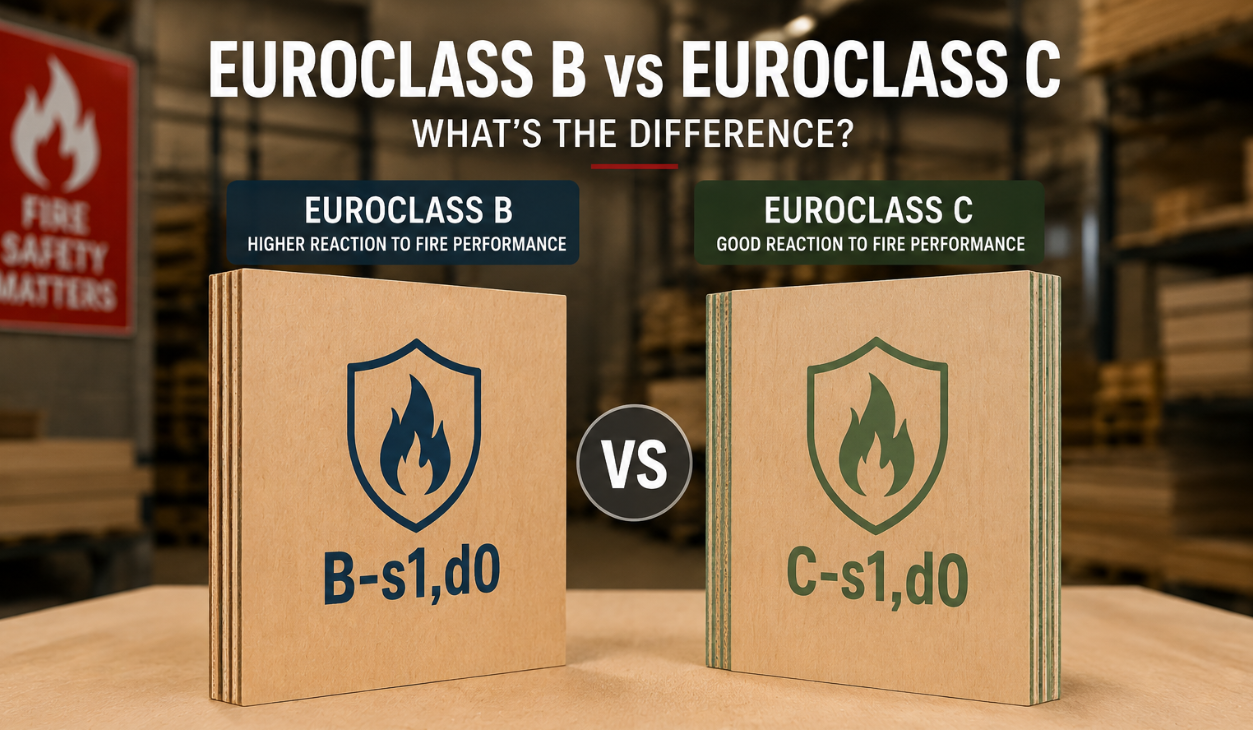
Euroclass B vs Euroclass C: What’s the Difference?
Euroclass B vs Euroclass C: What’s the Difference?
If you’re specifying fire-retardant plywood, MDF or other timber-based sheet materials, you may come across products described as Euroclass B or Euroclass C.
But what do these classifications actually mean?
And, perhaps more importantly, does choosing Euroclass B automatically make it the right choice over Euroclass C?
The answer isn’t simply that one board is “fireproof” and another isn’t.
Euroclass ratings form part of a recognised system for classifying how construction products react when exposed to fire under specified test conditions.
Understanding the difference between Euroclass B and Euroclass C can therefore help contractors, set builders, exhibition companies, shopfitters and specifiers choose appropriate sheet materials for their projects.
What Is the Euroclass Fire Classification System?
The Euroclass system provides a standardised method of describing the reaction-to-fire performance of construction products.
Reaction-to-fire classifications are determined in accordance with EN 13501-1 using results from specified fire tests.
The principal Euroclasses are:
A1
A2
B
C
D
E
F
Broadly speaking, the classifications progress from products making little or no contribution to fire at the top of the scale through to products with increasingly different reaction-to-fire characteristics.
However, the classification of a product should always be considered together with its complete test and classification information.
What Does Euroclass B Mean?
A product classified as Euroclass B has demonstrated a high level of reaction-to-fire performance within the Euroclass system, although it is not classified as non-combustible.
For timber-based products such as plywood or MDF, achieving a Class B classification can therefore represent significantly enhanced reaction-to-fire performance compared with conventional untreated wood-based panels.
Fire retardant treatments or specially manufactured boards may be used to achieve the required performance.
Euroclass B fire retardant plywood and appropriately classified FR MDF can consequently be useful for projects where this level of performance is specified.
The exact classification of the particular product should always be checked.
What Does Euroclass C Mean?
Euroclass C is another reaction-to-fire classification under EN 13501-1.
A Class C product demonstrates a different level of reaction-to-fire performance from Class B.
For many projects, Euroclass C fire retardant plywood may be entirely appropriate where Class C is the performance required by the project specification.
This is an important point.
Choosing fire retardant materials isn’t simply about buying the product with the highest classification available.
The objective should be to identify and supply a material that meets the specific requirements of the project.
Euroclass B vs Euroclass C
The principal distinction is their performance within the EN 13501-1 reaction-to-fire classification system.
| Euroclass B | Euroclass C | |
|---|---|---|
| Classification system | EN 13501-1 | EN 13501-1 |
| Reaction-to-fire class | B | C |
| Position within Euroclass system | Higher than C | Below B |
| Available for FR plywood | Yes | Yes |
| May be available for specialist MDF | Product dependent | Product dependent |
| Suitable for commercial applications | Depending on specification | Depending on specification |
| Automatically suitable for every project? | No | No |
| Certification should be checked? | Yes | Yes |
The most important question is therefore not:
“Is Euroclass B better than Euroclass C?”
It is:
“Which classification does my project require?”
Is Euroclass B Better Than Euroclass C?
In terms of reaction-to-fire classification, Class B represents a higher level of performance within the Euroclass system than Class C.
That doesn’t mean Euroclass B should automatically be specified for every project.
If a project requires Euroclass C and an appropriately classified Class C board satisfies all of the project’s other requirements, there may be no reason to specify Class B purely because it sits higher in the classification system.
Conversely, if the project specifically requires Class B, a Class C product should not simply be substituted without appropriate approval.
The project’s requirements should drive material selection.
What Do the Additional Letters Mean?
You may see a fire classification written in a form such as:
B-s1,d0
rather than simply B.
These additional classifications provide further information about how the product performed during the relevant testing.
The “s” Classification – Smoke
The letter s relates to smoke production.
The classifications are:
s1
s2
s3
with s1 representing the most limited smoke production within this classification scale.
The “d” Classification – Flaming Droplets and Particles
The letter d relates to flaming droplets and particles.
The classifications are:
d0
d1
d2
A d0 classification indicates that no flaming droplets or particles were observed within the specified criteria of the classification.
Therefore, when comparing two fire retardant boards, it is important to consider the complete classification, not simply whether the first letter is B or C.
What Does B-s1,d0 Mean?
A classification such as:
B-s1,d0
contains three pieces of information:
B – the primary reaction-to-fire classification.
s1 – the smoke-production classification.
d0 – the flaming-droplets/particles classification.
This gives the specifier considerably more information than simply describing a product as “fire rated” or “fire retardant”.
When purchasing FR plywood or MDF for a project requiring a particular classification, the complete classification should therefore be checked against the specification.
Reaction to Fire vs Fire Resistance
Another important distinction is between:
Reaction to fire
and
Fire resistance.
These terms describe different aspects of fire performance.
Reaction to Fire
Reaction to fire considers how a product behaves when exposed to fire, including characteristics assessed within the Euroclass classification system.
This is where classifications such as B-s1,d0 and C-s1,d0 may be encountered.
Fire Resistance
Fire resistance generally relates to the ability of a building element or assembly to maintain particular functions, such as integrity, insulation or load-bearing capacity, for a specified period under defined test conditions.
A sheet of fire retardant plywood is therefore not automatically a “30-minute fire-resistant wall”, for example.
The performance of a complete wall, floor or other construction system is a different consideration from the reaction-to-fire classification of an individual sheet material.
Does Euroclass B Mean Fireproof?
No.
Neither Euroclass B nor Euroclass C means that plywood, MDF or another wood-based material is completely fireproof.
The term “fireproof” is frequently used informally, particularly in online searches, but it can be misleading.
Euroclass classifications provide a much more useful way of describing a material because they relate to performance demonstrated through recognised testing and classification procedures.
When specifying a product, therefore, it is better to ask:
“What is the product’s reaction-to-fire classification?”
rather than:
“Is this plywood fireproof?”
How Does Plywood Achieve Improved Fire Performance?
Plywood can be manufactured or treated to provide enhanced reaction-to-fire performance.
One approach involves the controlled impregnation of timber with specialist fire retardant chemicals.
This differs from simply applying a fire retardant coating to the visible surface of a finished board.
The exact manufacturing or treatment process will depend upon the product.
Creffields supplies specialist fire retardant plywood, including products available with Euroclass B and Euroclass C classifications.
When selecting treated plywood, the classification and technical documentation applying to the actual product supplied should always be checked.
What About Fire Retardant MDF?
Specialist fire retardant MDF (FR MDF) is also available where the characteristics of MDF are preferred.
MDF offers advantages including:
- A smooth surface
- Consistent density
- Excellent machining characteristics
- Good routing performance
- Suitability for painted finishes
- Ability to create detailed decorative components
FR MDF can therefore be particularly useful within:
- Shopfitting
- Commercial interiors
- Film sets
- Television sets
- Theatre scenery
- Exhibition stands
- Displays
As with plywood, the specific classification of the FR MDF being considered should be checked against the project’s requirements.
Euroclass B and C Plywood for Film & Television
Film and television sets can incorporate substantial quantities of timber-based materials.
These might include:
- False walls
- Floors and platforms
- Building facades
- Shop fronts
- Scenic structures
- Props
- Decorative features
- Furniture
- Temporary interiors
Productions may have specific requirements concerning the reaction-to-fire performance of materials used within sets and studios.
Where fire retardant plywood is specified, the production team should establish the classification required before ordering.
Creffields has extensive experience supplying specialist sheet materials to the film, television and scenery industries.
Fire Classifications for Theatre Scenery
Theatres are another environment in which the fire performance of materials can be particularly important.
Stage scenery may incorporate:
- Plywood
- MDF
- Timber
- Fabrics
- Paints
- Decorative coatings
- Plastics
- Numerous other materials
The appropriate requirements will depend upon the venue, production and application.
Contractors should therefore check the relevant requirements rather than assuming that all theatre scenery automatically requires the same Euroclass.
Where FR plywood or FR MDF is specified, Creffields can provide suitable product information to help customers identify appropriate options.
Fire Retardant Boards for Exhibition Stands
Exhibition organisers and venues can have specific requirements relating to materials used for stand construction.
These may affect:
- Walls
- Platforms
- Display structures
- Counters
- Signage
- Storage areas
- Decorative features
An exhibition contractor might therefore be asked to demonstrate the fire classification of materials being used.
This is another reason why purchasing properly documented fire retardant boards from a specialist supplier can be important.
Why Technical Documentation Matters
When buying specialist fire retardant boards, don’t rely solely on the colour of the board, a product name or a general claim that it is “fire rated”.
Relevant documentation can help establish:
- Product identification
- Reaction-to-fire classification
- Testing/classification standard
- Thicknesses covered
- Mounting conditions
- Substrate requirements
- Intended application
- Other limitations or conditions
Creffields provides access to technical information and product documentation for many of the specialist sheet materials it supplies.
Does Board Thickness Affect the Classification?
Potentially, yes.
A fire classification does not necessarily apply to every possible thickness of a particular type of board.
Testing and classification documentation may define the thickness or range of thicknesses to which the classification applies.
This means that you shouldn’t simply see that a particular plywood product has achieved a Euroclass B classification and assume that every available thickness automatically carries exactly the same classification.
Always check the documentation covering the board being ordered.
Can Painting Affect Fire Performance?
Potentially.
A tested board and a completed installation are not necessarily the same thing.
Adding:
- Paint
- Laminates
- Decorative coatings
- Veneers
- Fabrics
- Adhesives
- Other coverings
can potentially affect the behaviour of the finished system.
Where a particular fire classification is essential, the impact of finishes should therefore be considered.
This is particularly relevant to film sets, theatre scenery, exhibitions and shopfitting, where sheet materials are frequently heavily decorated after fabrication.
How Do I Know Whether I Need Euroclass B or C?
Start with the project’s specification.
The required classification may be determined by factors including:
- Type of project
- Intended application
- Building design
- Location of the material
- Venue requirements
- Fire strategy
- Relevant regulations and guidance
If the required classification isn’t clear, don’t guess.
Ask the project’s responsible designer, fire consultant, building-control professional, venue representative or other appropriate responsible person to confirm the required performance.
Once you know the required classification, Creffields can help identify products capable of meeting the material specification.
Choosing the Correct Fire Retardant Board
Before ordering FR plywood or MDF, establish:
Required classification
Is the requirement Class B, Class C or something else?
Complete classification
Does the specification include smoke and flaming-droplet requirements?
Material
Do you require plywood, MDF or another sheet material?
Thickness
What thickness is required, and is it covered by the relevant classification?
Application
How will the material be used and installed?
Finish
Will it be painted, laminated or covered?
Documentation
What certification or technical information will the project require?
Answering these questions before ordering can avoid expensive problems later.
Euroclass B and Euroclass C Fire Retardant Boards from Creffields
Creffields supplies an extensive range of specialist timber-based sheet materials, including fire retardant plywood and fire retardant MDF.
Our experience includes supplying materials for:
- Film and television
- Theatre and scenery
- Exhibitions
- Events
- Shopfitting
- Commercial interiors
- Construction
- Timber and building merchants
Our fire retardant plywood range includes products available for projects requiring Euroclass B and Euroclass C reaction-to-fire classifications.
Creffields can also provide access to technical documentation to help customers determine whether a particular product meets their project’s requirements.
Frequently Asked Questions
What is the difference between Euroclass B and Euroclass C?
Both are reaction-to-fire classifications under EN 13501-1. Class B represents a higher reaction-to-fire performance level within the Euroclass system than Class C, but the correct choice depends upon the project’s specification.
Is Euroclass B better than Euroclass C?
Euroclass B sits above Class C in terms of reaction-to-fire classification. However, this doesn’t automatically mean Class B is the correct material for every project. The required classification should be determined by the project specification.
What does B-s1,d0 mean?
B is the principal reaction-to-fire classification, s1 relates to smoke production and d0 relates to flaming droplets and particles.
Is Euroclass B plywood fireproof?
No. Euroclass B does not mean that plywood is completely fireproof. It describes the product’s reaction-to-fire performance under the applicable classification system and test conditions.
What is EN 13501-1?
EN 13501-1 is the European standard used to classify construction products according to their reaction-to-fire performance based on relevant test results.
Can plywood achieve Euroclass B?
Appropriately manufactured or treated plywood can achieve a Euroclass B classification where demonstrated by the applicable testing and classification documentation.
Can MDF achieve Euroclass B?
Specialist fire retardant MDF products are available with enhanced reaction-to-fire classifications. Always check the documentation for the particular product, thickness and application.
Do exhibition stands need Euroclass B materials?
Requirements vary according to the venue, organiser, application and project. Contractors should establish the specific requirements before purchasing materials.
Which is better for fire retardant applications, MDF or plywood?
It depends upon the application. Plywood may be preferable where strength, weight or fixing performance is important. MDF can be particularly suitable where smooth surfaces, painted finishes or detailed machining are required.
Need Help Choosing Euroclass B or Euroclass C Boards?
Selecting fire retardant sheet materials shouldn’t involve guessing at the required classification.
The correct product depends upon the project specification, required Euroclass, material, thickness, application and finish.
Creffields supplies specialist Euroclass B and Euroclass C fire retardant plywood, FR MDF and other sheet materials to customers across the UK.
Contact the Creffields team with your project requirements and we can help you identify suitable products, availability and supporting technical documentation.